An Open Letter to Hiring Teams Living With Technical Recruiting’s Interpretation Problem
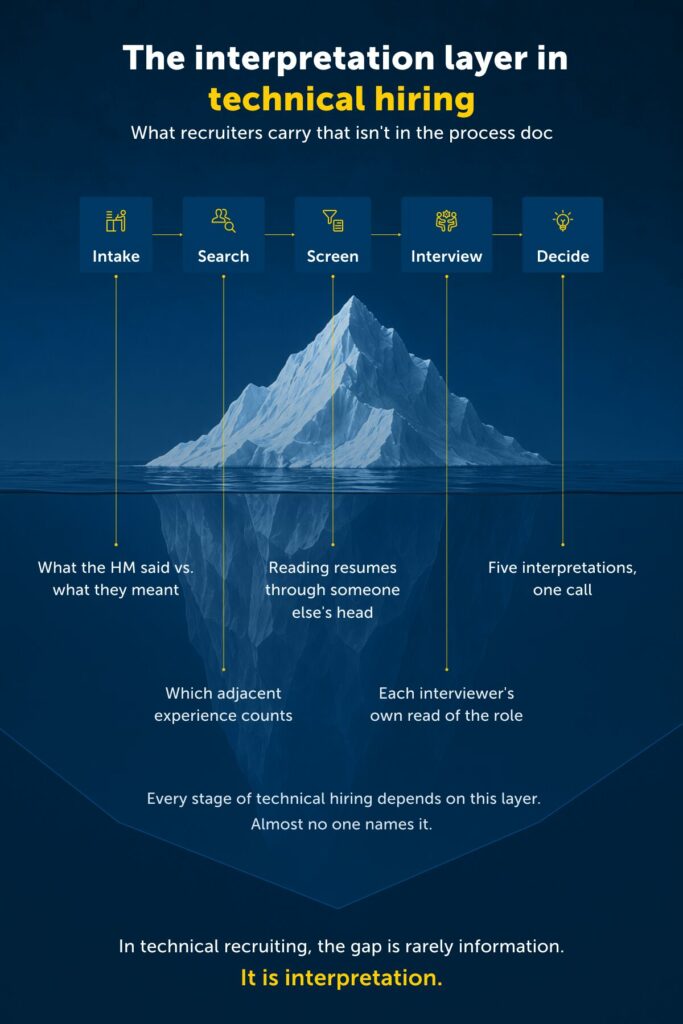
Dear hiring leaders and recruiters, there is a part of technical hiring you will not find in any process document: the quiet work of interpretation that you carry every day.
As technical roles have become more specialized, success depends not just on defining the job on paper but on translating a hiring manager’s full intent including the technical nuance behind the role into consistent screening and evaluation across the process.
Talent acquisition spends a lot of time talking about speed, quality, and efficiency. But we talk far less about the amount of guesswork still built into the earliest stages of technical hiring. The standard model assumes that once a hiring manager explains the role, the recruiter can take that input, translate it cleanly, and carry it forward across sourcing, screening, and interview preparation. In simpler roles, that may be enough. In technical hiring, it often is not.
Because the real requirements of a role rarely live neatly inside the job description.
They live in the nuance around it.
A hiring manager might say they need “someone strong in X” or “hands‑on with Y,” but what they actually mean is often much more specific: someone who has solved certain kinds of problems in real projects, not just someone who can list a tool on their resume. At the same time, recruiters will quite reasonably shortlist candidates whose experience looks directionally similar, even if it does not match that narrow definition perfectly.
None of this happens because recruiters are careless.
It happens because technical hiring asks recruiters to interpret a level of nuance that is often difficult to infer unless you already have the same technical lens as the hiring manager.
And that is exactly where the current model becomes too demanding.
And it is not solved simply by hiring technical recruiters. They may be closer to the domain, but technology is evolving too quickly for anyone to stay fully current across every emerging area, every adjacent technology, and every changing requirement. In many cases, even hiring managers themselves are still learning and refining what good looks like. That is exactly why relying only on individual expertise is not enough.
We have normalized an expectation that recruiters should carry a near-360-degree understanding of a role from the hiring manager’s point of view, both the general context and the technical meaning behind it and then apply that uniformly at scale.
That is a lot to ask of any one person.
That is why this issue is not just about context.
It is about interpretation.
The friction starts when hiring managers assume the nuance is obvious, recruiters interpret it through the lens of what they know, and the process moves forward as if everyone is aligned. Sometimes they are. Sometimes they are not. And when they are not, the consequences show up downstream: weaker shortlists, more iterative feedback cycles, inconsistent early validation, and hiring managers spending time on candidates who looked close enough on paper but were never truly aligned to the role as intended.
This is where AI becomes useful in a much more practical way than most hiring conversations suggest.
Not as an automated judge. Not as a recruiter replacement. But as a way to reduce the domain gap.
AI can help surface the nuance a recruiter may not know to ask about, connect what the hiring manager meant to signals in the resume, and insert that awareness into the workflow at the right moment. It can help distinguish between experience that is merely adjacent and experience that is genuinely relevant. It can help recruiters ask better follow-up questions, validate candidates more effectively, and carry forward the right understanding of the role from one stage to the next.
That matters because better interpretation leads to better validation, and better validation leads to stronger candidate quality downstream. When that happens, hiring managers spend more time with candidates who genuinely fit the role and less time on interviews that should never have happened in the first place.
This is very much the direction we have been exploring internally at Fusemachines. Through our Interview Agent, we are testing what it looks like when AI supports a more context-aware, more nuanced approach to technical screening. What stands out is not simply that it can help the process move faster. It is that it can help bridge the gap between what a hiring manager means and what a recruiter can reliably infer on their own.
To me, that is the more important shift.
Technical hiring does not just need better process discipline. It needs a model that asks less guesswork of recruiters and gives them better support where nuance matters most.
Because in technical recruiting, the gap is rarely information.
It is interpretation.

Interview Agent helps teams carry context from intake through interviews and debriefs so recruiters and hiring managers stay aligned on what actually matters.